Surfing With an AccentThe mini book
Chapter 01 of 13Full book ↗

Surfing With an Accent, abridged

Two threads. One question.

The odd chapters follow a middle-aged beginner into bigger water. The even chapters ask what science says about learning after the convenient age has passed.

Read from the beginning

This is the abridged adaptation. The Kindle edition has the original prose, full scenes, research, sources, and every useful side road.

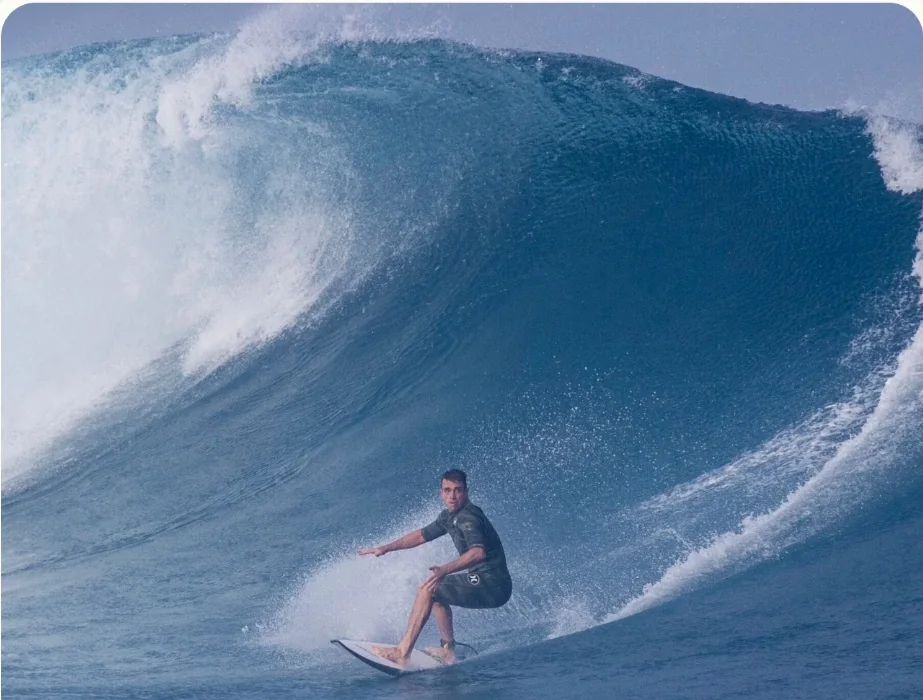
Andrew surfing Cloudbreak in Fiji
StoryWhat happened.ScienceWhy it mattered.
01

Story chapter

All Saints

A 4 a.m. boat ride, a lighthouse, one enormous wave, and the failure that started the whole project.

I said, “Sounds good,” while thinking, I want to go home.

The safety briefing was not reassuring

Several miles offshore, in the dark, Grant explained the radar, the spinal backboard, and the satellite phone. We were threading a 26-foot boat between oil tankers on our way to an island off Mexico where there would be no cell service and nobody within ten miles. The wave was called Killers. This all felt like useful information to receive before sunrise.

Grant is six-foot-four and built like a refrigerator that learned to drive a boat. He talked through the emergency plan with the energy of a second grader describing laser tag. I tried to match his enthusiasm while quietly reviewing the much simpler emergency plan in my own head: do not require an emergency plan.

I had grown up in Michigan, spent fifteen years in Chicago, and moved to San Diego only two years earlier. Surfing gave me sun, exertion, failure, small victories, and a reliable way to disappear into nature. It also gave me the suspicion that I had found the thing I loved after the convenient age for becoming good at it. That suspicion is how I ended up taking safety instructions from Grant in the dark.

Peace and terror can share a seat

Todos Santos appeared at dawn, with its red-and-white lighthouse above a rocky peninsula that points into the Pacific like a middle finger. The rock forces incoming swell into one of the largest rideable waves on earth. Grant had surfed since childhood. I had been serious about it for two years. He thought we were ready. I thought he was using the word we generously.

We paddled out and waited on water so calm I could see my reflection. Waiting was a potent cocktail of peace and terror. The peace came from being alone in a beautiful, empty ocean. The terror came from knowing the ocean could revoke that arrangement without notice.

A few lines appeared on the horizon. They grew until they swallowed it. Grant sprint-paddled toward the channel. I followed, mostly because the largest man in the water had decided to flee. The wave caught us anyway, drove me into darkness, and spun me until the leash around my ankle became my only clue to the surface.

Naturally, we went back out

When I surfaced, Grant yelled, “Let’s get our bigger boards. It’s bigger than I thought!” Still white with fear, I answered, “Sounds good,” while thinking, I want to go home.

Grant returned wearing padded flotation that made him look like a musclebound superhero. I returned on a borrowed board I had never ridden, conspicuously without flotation. This did not seem fair. For four hours he caught waves and I avoided them. Each attempt felt like launching myself face-first down a double-black-diamond ski run on a waxed saucer.

I caught nothing. On the paddle back, I complained that I had come all this way for zero waves. Grant told me that learning to surf as an adult was like learning a language late. I could become fluent, but I would always have an accent.

Big waves move faster than small ones, which means you must start paddling earlier and keep paddling longer. At Todos, the correct move is to aim toward the rocky point, build speed beside the impact zone, and stay committed while the ocean rises behind you. Every instinct says stop. The wave treats hesitation as an invitation.

Catching nothing became the beginning

On the boat home, I sat on a beanbag, opened a beer, and began organizing a very respectable midlife crisis. What frightened me about aging was not the number. It was the possibility that life would narrow, that novelty would become memory, and that I would become a spectator.

So I made a plan. I would find mentors. I would break the challenge into pieces. I would learn what age changes, what it does not, and how an adult can compensate. I thanked Grant about forty-two times before he hugged me, said he was proud, and redirected my abundant gratitude toward cleaning the boat.

When I made it home, the hugs from Sara and our baby felt unusually specific. I had not cheated death, but I had spent a day close enough to the possibility that ordinary life looked newly extravagant. Catching no waves turned out to be a useful way to notice everything I had returned to.

02

Science chapter

Critical Periods

The adult brain is not poured concrete, and nobody gets to ring a closing bell on learning.

As an adult learner, there are no truancy officers. Go get lost on your own timeline.

It is a historically excellent time to get old

Our prehistoric ancestors would have had little interest in adult learning. Their bigger problem was death. For most of human history, very few people lived long enough to wonder whether forty was too late to learn guitar, Mandarin, or how to ride a large wall of water without dying. A midlife crisis at sixteen would have been efficient, if brief.

We now live much longer while the world changes much faster. I can remember life before personal computers, mobile phones, and the internet. Our ancestors could be born with the finest spear technology available and die with the same model still dominating the market. We do not get that kind of product stability.

Critical periods are real, but they are not trapdoors

Scientists once described the adult brain like poured concrete. Childhood was malleable. Adulthood was cured. Miss the window and the switch turned off forever. Language seemed to prove it: learn late and you speak with an accent.

The evidence is messier and more encouraging. Some capacities decline with age, especially the young brain’s remarkable ability to mimic unfamiliar sounds. But learning does not fall off a cliff. It follows a slope. Teenagers can acquire vocabulary and grammar faster than toddlers, even if toddlers win on pronunciation. I have watched a three-year-old lick peanut butter from a napkin, so I remain cautious about declaring toddlers superior at all complex tasks.

Language is a bundle of abilities, not one switch. The adult brain may lose some facility for unfamiliar sounds while gaining memory, attention, vocabulary, and the ability to understand rules. A fifteen-year-old can learn a second language faster than a three-year-old and still sound less native. Fluency and accent are measuring different parts of the same mosaic.

The brain shuffles the tiles

Complex abilities are mosaics assembled from many regions of the brain. As we age, some tiles become less available and others get recruited. This process, often called scaffolding, lets the older brain solve new problems with different circuitry. It may be slower. It is still learning.

Imagine a medieval Blacksmith disappears and the Butcher and Baker take over. Their first horseshoes might lack elegance. The horses will still have shoes. Given time, practice, and feedback, the substitutes may become excellent. They may even bring useful experience from meat, bread, customers, and the brutal competition in the medieval food space.

The brain itself resembles a house that kept adding floors during evolution. The ancient amygdala, which dinosaurs also possessed, helps sound the alarm. The newer frontal lobe handles planning, language, memory, and the work of telling the amygdala that a shadow is probably a coat. Adult learning succeeds when these systems recruit one another instead of waiting for a childhood circuit to reopen exactly as it was.

School gave learning an artificial clock

School taught many of us that learning happens between bells, inside a building, on a schedule sorted by age. Summer arrives because, apparently, the crops need us. I never harvested anything during vacation and still boycott U-Pick strawberry farms, which have managed without me.

Humans evolved to learn through participation, play, imitation, and experience. Adults can reclaim that. Nobody marks you late. Nobody gives detention because you started piano at fifty. You get to choose the pace, the teacher, and the path.

The difficult part is the F-word: fun. Children can afford obsession. They play because the activity itself keeps pulling them back. Adults have calendars, bills, and the instinct to turn every hobby into a performance review. If the process is miserable, you will not stay with it long enough to become good. The adult learner needs discipline, but also a playground. For me, that meant Fiji.

A twelve-year-old surfer named Betty-Lou explained the remaining advantage of youth without mentioning neuroscience. She surfed before school, after school, and all weekend because the ocean was where her friends were. Kids can afford to be obsessed. Adults have jobs, calendars, and a talent for converting pleasure into obligation. The adult learner has to protect fun with the same seriousness used to protect practice.

03

Story chapter

Cloudbreak

A motorcycle stunt, a rescue jet ski, three attempts, and one very public loss of bladder control.

I did not want to look incompetent and scared, so I settled for incompetent.

The end of the world had a motorcycle ramp

Todos stayed in my head because I had gone all that way and caught nothing. I surfed constantly, waited for larger waves, and eventually accepted an eight-day permission slip from Sara to chase a swell to Tavarua, Fiji. She understood that I was a better partner when I had something difficult to chase. She is far too good a person for me.

Cloudbreak sits miles offshore on a shallow reef. There is no land in sight, only a wooden judging tower that looks like Mad Max might live there. Deep-water swell arrives with very little energy lost and folds into a hollow wave of astonishing power.

On my first day, someone had built a runway on a barge because a motorcycle stunt rider planned to ride Cloudbreak. I will repeat that for clarity: a motorcycle, on one of the most powerful waves in the world. The scene included jet skis, drones, cameramen, and enough machinery to make the altar of nature feel like Waterworld. I went to the smaller wave at Restaurants and, to my credit, did better than the guy on the motorcycle.

California swell crosses miles of continental shelf before reaching shore, shedding energy as it travels. Cloudbreak rises from deep water onto shallow reef with almost nothing to slow it down. Storm energy marches across the South Pacific, reaches a reef shaped roughly like a chili pepper, and becomes a perfect hollow wall. The geography is beautiful in the same way a loaded cannon can be beautifully engineered.

The excuse left the island

The stunt crew failed to get the shot and left. The water-safety team stayed. The next morning I woke before dawn and realized I could no longer blame a motorcycle for remaining on the boat.

Professional big-wave surfer Kohl Christensen caught a wave so large he could stand inside its barrel with both hands over his head and still not touch the ceiling. Watching him was equal parts beautiful and unhelpful. Then Abe, one of the world-class lifeguards on a rescue ski, asked if I wanted to try.

I repeated a brave internal speech about only living once while actually peeing on the back of his jet ski. Courage and bladder control are separate faculties.

Three attempts

Abe accelerated down the face and yelled, “Jump now.” I jumped, buried the nose of my board, and skipped down the wave before the lip picked me up and drove me into black water. I climbed my leash to the surface, where Abe smiled and asked, “What did you do that for?” I hoped he would take me back to the boat. He told me to get on because we were doing it again.

I did not want to look incompetent and scared, so I settled for incompetent. On the second attempt, the wave ran away before I could stand. The boat erupted for the empty barrel. Abe returned and told me I was close.

On the third, I landed cleanly, stood, and carved down a moving two-story wall. The reef seemed to rise toward me as the wave drew water from its base. I sped toward safety, convinced the barrel was about to eat me. Later I learned I had been roughly thirty yards in front of the dangerous part. The professional had reached for the ceiling. I had fled the building.

The wave I missed

That evening, a photographer told me the second wave would have been the barrel of the swell if I had made it. I told him I wished he had kept that information to himself. He added that I either would have made the barrel or died. Suddenly I felt at peace with missing it.

The experience clarified the problem. I had gotten fitter and spent more time surfing, but I had not deliberately trained the pieces that made big waves survivable. I was pushing the size of the consequence faster than the quality of my preparation.

I had learned enough to catch a powerful wave. I had also learned enough to see my own accent. That difference between experience and fluency became the next question.

Fatherhood had made me cautious in every ordinary setting. I glared at drivers who rolled through crosswalks, distrusted teenagers on principle, and wore reflective gear while biking in daylight. Then I flew across the Pacific to jump from a moving jet ski onto a wave over shallow reef. A midlife crisis may be the moment when risk tolerance becomes highly selective and impossible to explain at home.

04

Science chapter

Surfing With an Accent

Why late learners look different, where adults have an edge, and what old owls know about smaller steps.

The old owls caught up when the change came in smaller pieces. Take that, kids.

Newcomer’s Anxiety

When I first paddled into a surf lineup, I was certain everyone knew I did not belong. I imagined a group text where lifelong surfers reviewed my style, etiquette, and board choice in real time. Years later, I confirmed the chat did not exist. Most people were busy thinking about themselves.

I call this Newcomer’s Anxiety: the belief that everyone else received the instructions years ago and can see that you are improvising. It is especially strong for adults because we have identities to protect. Children can be bad at things in public without believing it invalidates their careers. Adults would rather remain competent in private than become beginners in daylight.

Adults usually enter a new room carrying a résumé of competence. We know how to run meetings, pay bills, raise children, and offer confident opinions about subjects we discovered that morning. Beginnerhood takes that identity away. The fear is rarely limited to failing. We fear being observed while failing, which is why an imaginary audience can keep a capable adult safely mediocre for years.

Children build languages

The young mind has genuine advantages. On Hawaiian plantations, adults who spoke different languages assembled a functional pidgin. Their children turned it into a creole with grammar. Deaf children in Nicaragua did something similar with sign language. The younger mind did not merely copy a system. It helped create one.

This is why late language learners often keep an accent. Some machinery for mimicking and creating language is strongest early. My surfing worked the same way. I could catch and ride waves, but someone who learned young moved with an ease I could recognize and could not fake. My family insisted I had mastered it because I was unemployed and surfed all the time. This was supportive and factually incomplete.

The older mind is a Swiss Army knife

Young minds are specialists. They are busy developing senses, language, balance, and the basic operating system required to be human. Older minds are generalists. They have less native machinery for some tasks, but more patterns, analogies, judgment, and experience to recruit.

Learning late can feel like assembling an IKEA dresser without instructions. It takes longer, you may swear, and a part will remain on the floor. The dresser can still work. For many adult tasks, the generalist mind is exactly what the problem needs.

That difference is not a verdict on the older mind. Childhood is devoted to known developmental jobs: calibrate sight and hearing, acquire language, learn balance, build the basic human interface. Adulthood is full of problems for which evolution left no instructions. The older mind gives up some specialist machinery and gains a lifetime of examples. It becomes less like a single perfect tool and more like a drawer that can solve an alarming number of household problems.

Ask the old owls

Researchers fitted barn owls with prisms that shifted their vision. Young owls recalibrated quickly. Old owls struggled. Bad news for old-timers everywhere.

Then the researchers changed the experiment. They introduced a small visual shift, gave the older owls time to adjust, then increased it in stages. Many of the old owls eventually matched the young ones. The final challenge was the same. The route was smaller, slower, and designed around the older brain.

My mistake had been asking an old-owl brain to solve every part of big-wave surfing at once: equipment, positioning, fear, breath, paddle technique, wave selection, rescue, and the minor matter of standing up. Age was relevant. It was not a verdict. The design response was obvious: break the challenge down, train the pieces, and give the brain enough time to build a new route.

05

Story chapter

Do Hold Your Breath

A freediving class, a ladies’ book club, a hangover, and the panic attack I tried to call nausea.

Being forced not to breathe is like being trapped in a tiny room with your own voice screaming.

Sharks were not the problem

My grandmother was sure a shark would eat me. Sharks have excellent public relations for fear, but the more relevant big-wave hazard is drowning. If I was uncertain I could survive a hold-down, that doubt would follow me into every takeoff.

So at forty-one, unemployed and rich in discretionary anxiety, I enrolled in a four-day freediving course. Freedivers take no air underwater. Competitive apnea is essentially a collection of increasingly creative ways to torture yourself by refusing to breathe.

The statistics were oddly comforting. In the United States, cars, dogs, cows, bees, snakes, and spiders all kill more people than sharks. Mosquitoes operate in another league entirely. Sharks earned the movie franchise, but the drive to the beach was the more serious risk. In big surf, the danger worth training for was simple: too much water above me and not enough air inside me.

The class inspired confidence, eventually

The pool looked like it had last been renovated when ashtrays were considered furniture. Our instructor went by Chris, although his legal name was Dagon. He had a neck tattoo, gauged ears, and the calm demeanor of someone who had voluntarily spent far more time without oxygen than I had.

The waiver listed many ways I might die and clarified that none would be his fault. We learned the science of carbon dioxide, blackout, rescue breaths, and exactly how long a person can be unconscious before the lesson becomes a memorial. This was somehow reassuring.

The first urge to breathe is driven mostly by rising carbon dioxide, not an immediate absence of oxygen. That alarm can become violent while the body still has usable oxygen. It can also become dangerously quiet before a blackout, which is why freedivers train with partners, watch one another closely, and practice rescue breaths. The course converted a vague terror into sensations, stages, and procedures. Naming the sequence made it less mystical and more manageable.

Three minutes hurt

My first three-minute breath hold hurt in a way exercise never had. When you sprint, your body begs for air and you give it some. During a static hold, the alarm keeps sounding and no help arrives. It is like being trapped in a tiny room with the sound of your own voice screaming.

That night, Sara hosted a ladies’ book club. The group engaged in the intellectual exercise of drinking wine and not discussing the book. I offered to wash dishes and accomplished more wine drinking than dish cleaning. This was poor preparation for a maximum breath hold the next morning, which required an empty stomach, no coffee, and ideally no hangover.

I drove to class weak, anxious, and looking for an excuse to turn around. None arrived.

The breathing routine began before the hold. Slow ventilation lowered tension, the buddy system removed the need to perform alone, and stillness exposed every unhelpful thought. I had assumed fitness would carry me. Fitness helped. The harder skill was refusing to treat discomfort as proof of emergency.

The panic was useful information

On the pool deck, my heart raced, my vision narrowed, and I became certain something was wrong. I told the instructor I felt nauseous. The more accurate diagnosis was panic attack, but nausea felt less revealing in a room full of people preparing to hold their breath.

I failed the attempt and felt ashamed. The next day, rested and sober, I followed the breathing routine, trusted my buddy, and stayed present. I completed an exhale hold that had terrified me before.

On the final day, I attempted a two-minute hold after exhaling, roughly the psychological equivalent of a much longer full-lung hold. The day before, the idea had helped trigger panic. This time I slowed down, followed the routine, and made it without drama. My lungs had not transformed overnight. My interpretation of the alarm had. That was the capacity I wanted to bring back to the ocean.

06

Science chapter

Neuroplasticity

The brain can reroute itself, but it charges labor, repetition, and a willingness to crawl around the garden.

The adult brain changes when you give it a reason, then keep giving it the same reason.

The Blacksmith comes home

Imagine our missing Blacksmith returns after an unsuccessful reinvention as a life coach. Exhausted from dispensing unqualified advice, he discovers he prefers horses and steel to people. After a few clumsy swings, his old skill returns faster than the Butcher and Baker can match it. Practice built durable roads in his brain.

For much of modern science, researchers believed those roads became fixed in adulthood. A damaged region meant a permanently lost function. The adult brain was a map with no construction budget.

The fixed-brain story once seemed obvious. Neurons looked like permanent telegraph wires, so a broken connection appeared to strand whatever function lived at the other end. Darwin had already noticed that wild rabbits had larger brains than domestic ones and suspected use mattered, but the scientific establishment preferred a tidier map. The map held until people kept doing things the map declared impossible.

A man learned to crawl again

Pedro Bach-y-Rita suffered a devastating stroke. Doctors expected little recovery. His son rejected that forecast and began teaching him like a child. Before Pedro could walk, he crawled through the garden in kneepads. The neighbors found the sight of a distinguished older man crawling around unsettling. Pedro kept going.

He progressed from crawling to standing, walking, talking, writing, working, remarrying, and traveling. An autopsy later showed enormous damage in the regions once believed essential to those functions. His brain had found other roads.

Pedro's rehabilitation flooded his nervous system with information. Crawling put vision, touch, balance, effort, and intention back into the same task. Sitting in a hospital bed asked almost nothing of the damaged network. Kneepads in the garden asked it to find a route. Repetition packed that route down until a path that looked lost became usable again.

A dentist chair helped blind people see

Pedro’s recovery inspired his son, neuroscientist Paul Bach-y-Rita, to test whether the brain could receive information through an unexpected route. He modified a dentist chair with hundreds of vibrating pins. A camera translated images into patterns on a blind person’s back.

After training, participants could identify lines, objects, and faces. It may be the most joy anyone has ever received from ten hours in a dentist chair. Later devices sent visual information through the tongue. The eyes were not seeing. The brain was learning what the signal meant.

Plastic does not mean easy

Neuroplasticity is the brain’s capacity to reorganize and grow connections in response to use. Musicians, martial artists, cab drivers, and stroke patients show measurable changes tied to what they repeatedly do. The brain is not fixed, but it is also not waiting eagerly to rebuild itself because you bought a notebook and announced a goal.

Late learners need sustained practice. The change is gradual, often inefficient, and sometimes routed through systems that evolved for other work. That is the cost.

The opportunity is that an older learner brings a broader library. The Butcher and Baker may be slower to shape a horseshoe, but they understand customers, supply chains, competition, and perhaps seasoning. The lifelong Blacksmith may be technically elegant and commercially miserable. In a messy problem, diverse experience can become an edge.

Repeated work changes brain tissue as well as pathways. Karate experts show differences in motor regions tied to striking. Professional musicians develop more gray matter in areas used for fine movement and sound. Practice is physical construction, even when the building site is hidden inside the skull. The phrase 'neurons that fire together wire together' is memorable because the underlying idea is blunt: the route you use becomes the route that is easier to use again.

07

Story chapter

As Safe As Dangerous Can Be

A romantic glamping weekend, a chance meeting, and the difference between courage and a rescue plan.

Sometimes a teacher, always a student.

Relationship work, with a surfboard

Southern California gets gloomy in early summer, which locals describe as hardship while wearing puffy jackets at sixty-four degrees. Sara and I escaped to Baja for a glamping weekend. My private plan involved wine, sex, and strengthening the relationship. I brought a surfboard, which weakened the sequence.

We paid luxury prices to sleep in a tent, drank wine, followed questionable dirt roads, and passed burros that seemed more confident in their route than Google Maps. I woke early to surf. Romance would begin after the morning session, a scheduling theory Sara had heard before.

The route to our luxury tent included dirt roads, wine, and burros who looked as if they had seen this category of tourist before. I told myself the surfboard was incidental to the romantic weekend. Then I woke before Sara and went surfing. A relationship can survive many things, including the discovery that your partner's definition of a shared itinerary has footnotes.

Luck introduced me to Vincente

A local connection led me to Vincente, a sponsored big-wave surfer and lawyer. His girlfriend was staying with him and had no interest in leaving, so a sequence of mildly inconvenient romantic circumstances placed me in front of the person I needed to meet.

Vincente invited me to a big-wave safety course taught by Greg Long, one of the most accomplished and thoughtful surfers alive. Greg had nearly drowned at Cortes Bank. His friend Sion Milosky had died in heavy surf. Their outcomes revealed the real meaning of safety.

Meeting Vincente looked like luck, and it was. It was also what happens when you keep telling people what you are trying to learn. A local friend knew a friend, a travel plan changed, and the next person in the chain happened to be a big-wave surfer who understood the gap between enthusiasm and readiness. Mentors often arrive through ordinary social generosity, then make extraordinary demands.

Preparation is a form of respect

Sion surfed without a dedicated safety team. Greg had trained rescuers on jet skis, practiced breath holds, and built redundancy. Even then, almost everything went wrong. He lost consciousness underwater and survived because the system around him expected failure from even the strongest surfer.

Greg taught the course because he could not tolerate the idea of someone dying unprepared. It felt as if every ocean was part of his watch. His mantra was simple: sometimes a teacher, always a student.

He praised what had worked in his own rescue and dissected what had not. That combination mattered. Confidence without review is ego. Fear without preparation is paralysis. Safety meant making a dangerous act as safe as dangerous could be, then remaining honest about what could still go wrong.

Greg's own rescue required trained partners, jet skis, flotation, communication, and people who kept searching after he disappeared beneath several waves. He still lost consciousness. Sion Milosky, another brilliant surfer, entered heavy water without the same dedicated system and did not come home. Skill did not explain the difference. Preparation, redundancy, and a team willing to rehearse the worst case did.

The pink board arrives

The class was full of rescue drills, CPR practice, talented teenagers, class clowns, and middle-aged men explaining fatherhood before making a point. I was old enough to recognize that the teenagers had years of ocean instinct I could not manufacture overnight.

Vincente helped me find a 10-foot-3-inch big-wave board. Elliot chose pink. The color was excellent for rescue visibility and guaranteed that nobody would mistake the board for someone else’s. We called it the Pink Padillac.

The board did not make me ready. The breath training did not make me ready. The safety course did not make me ready. Together, they made the next attempt less stupid. That was progress.

08

Science chapter

Newcomer’s Anxiety in a Wicked World

Why the imaginary audience is mostly asleep, and why messy worlds reward a broad life.

The audience in your head is usually asleep.

The imaginary audience

Newcomer’s Anxiety feels rational because humans are good at imagining other minds. We can picture what an expert sees when we walk into the room, and then we write the harshest possible review on that person’s behalf.

I did this in surf lineups. I also remember doing it as a teenager when a girlfriend suggested we might have sex. My mind produced an auditorium full of judges at the exact moment I would have preferred fewer observers.

The useful truth is that most people do not care that much. They are rehearsing their own mistakes, wondering how they look, or checking the time. The audience in your head is usually asleep. This is liberating.

A few years earlier, I had lived on the forty-second floor of a Chicago building and was so detached from the natural world that weather was something I watched through glass. Then I moved west, walked into a surf shop, and announced that I wanted to become a surfer. Nobody sounded an alarm. The humiliating secret was that the gatekeepers I feared had mostly failed to notice my arrival.

Kind worlds explain themselves

A Kind World has stable rules, repeatable situations, and clear feedback. Golf is kind. The ball waits. The hole stays put. You can repeat a swing, watch the result, and let a coach correct the movement. Deliberate practice works beautifully here.

Kind does not mean easy. It means the relationship between action and outcome is legible. A breath-hold timer, a CPR dummy, and video replay are kind. They let you isolate the skill and know whether it improved.

Learning usually moves through three modes. Play is exploration without a performance target. Purposeful practice adds a goal, repetition, and feedback. Deliberate practice adds a teacher and a system designed around a specific weakness. Adults often skip play because it looks unserious, then wonder why their new obsession feels like unpaid employment.

Wicked worlds keep changing the question

The open ocean is wicked. Wind, tide, swell direction, crowd, reef, equipment, fatigue, and fear interact differently every time. Feedback can arrive late or lie. A good decision can produce a bad outcome. A bad decision can survive long enough to become a habit.

Tennis is more wicked than golf because the ball arrives from another person who is actively trying to make your life worse. Roger Federer sampled many sports as a child. Tiger Woods specialized in golf almost immediately. Both paths produced genius, but the environments rewarded different learning histories.

Adults own a broader quiver

The 10,000-hour rule became famous because it was simple. The actual research was about deliberate practice among a small group of elite violinists. Ten thousand was an average, not a magic portal. Practice quality, environment, coaching, prior experience, and the structure of the task all matter.

Older learners may lack time and native fluency, but they have analogies. A surgeon, parent, manager, musician, skier, gardener, or teacher has patterns to borrow when confronting something new. In a wicked world, the broad quiver can outperform a single perfect tool.

The first move is still uncomfortable: enter the room, paddle out, take the lesson, and allow yourself to be seen before you are good. The second move is to remember that almost nobody is grading you.

This matters beyond sport. Creative people and scientists often make their best contributions after collecting ideas from several domains. The beginner's accent can carry useful patterns from another life. The stage is open to anyone willing to enter before the performance is polished. The fee remains embarrassment, payable in public.

09

Story chapter

Kelly Slater Wave Pool

The world’s most perfect artificial wave removed every excuse and charged handsomely for the service.

Video revealed a squatty-potty stance, ape arms, and the enthusiasm of a dog greeting its owner.

A sterile bubble on four wheels

I have always hated driving. Chicago gave me trains, taxis, and the pleasure of blaming someone else for traffic. California required two cars to support one family, which felt like a civic failure.

Then COVID arrived and the car became a sterile bubble with snacks. An airplane felt like sharing a cup in a leper colony. When I received an invitation to Kelly Slater’s Surf Ranch, a family road trip to central California became the safest available form of pilgrimage.

I accepted the invitation with the secrecy of someone arranging an illicit purchase. The family would already be driving north, Elliot could swim in the shallow water, and I could pretend the trip had not been reorganized around a machine that made perfect waves. This was plausible only because Sara had years of practice recognizing my definitions of coincidence.

The ocean, engineered into a Kind World

Kelly Slater dominated surfing longer than Michael Jordan dominated basketball. Jordan is the Kelly Slater of basketball, a sentence designed to irritate basketball fans and accurately rank the sports in my home.

Kelly’s wave pool uses a giant train-like machine to pull a perfect swell down a long basin. The same wave appears on command. The wind, tide, and reef have been removed. A coach watches. Cameras capture everything. Surfing, normally one of the wickedest learning environments, becomes kind.

The admission price was roughly five thousand dollars, which made each wave feel like a small used car. There was nowhere to hide. If I failed, I could not blame the ocean.

The pool also stripped away the usual negotiations. In the ocean, every wave is different enough to support a detailed excuse. At the ranch, the machine sent the same invitation down the same line. The only variable with a mortgage was me.

The video was unkind

My first wave felt glorious until the barrel closed like a guillotine. Other surfers fell too, and I experienced the quiet relief of schadenfreude. This is an unattractive emotion, but a reliable one.

Then we watched video. What had felt athletic looked like a squatty-potty stance, ape arms, and the frantic enthusiasm of a dog greeting its owner after a long day. Immediate feedback is valuable. It is also rude.

The coach gave me specific corrections. On the final attempt, I stayed lower, delayed the rush, and held a cleaner line inside the barrel. The wave repeated. I changed. That is the bargain of a Kind World.

That clarity is why Kind Worlds are so effective. One correction, one more attempt, one visible result. The experience was expensive, artificial, and extremely useful, which is also a fair description of many good teachers.

Even Kelly has an accent

Elliot splashed in the shallow end and treated the world’s most engineered wave like a very expensive swimming pool. Her joy was less technical and probably healthier.

Then Kelly arrived. I responded with the composure of a middle-school girl meeting a boy band. When I explained the book, he told me that he felt an accent in jiu-jitsu and even in certain big waves. The greatest surfer in history still carried an if only.

Kelly's comment mattered because he did not describe the accent as shame. Jiu-jitsu had put him back in the beginner's body. Certain big-wave situations still exposed gaps in his own experience. Expertise was specific, not a magical property that followed him into every room. I drove away with a cleaner barrel and a healthier suspicion of anyone who claims to have finished learning.

10

Science chapter

Idiot Enough to Try

A seventy-five-year-old runner, a cemetery training loop, and the practical case against resignation.

Ed Whitlock’s secret was that he was idiot enough to try.

The old man ran a 5:41 mile

At seventy-five, Ed Whitlock ran a mile in 5:41. At seventy-three, he became the first person over seventy to run a marathon under three hours. People wanted the secret: shoes, diet, coach, watch, supplement, ancient breathing ritual.

Ed wore old shoes, skipped the watch, trained without a coach, and offered no clean recipe. He said he was simply idiot enough to try.

I imagined my twenty-year-old self at a University of Michigan soccer fitness test, confident in the young body I had trained all summer. Then I placed Ed beside me at seventy-five and watched him run a 5:41 mile. He had returned to serious running in his forties after a twenty-year break. Late start, old body, grandpa speed. The timeline was already refusing to behave.

Aging is real and less theatrical than advertised

Bodies accumulate damage. Cells copy themselves imperfectly. Telomeres shorten. Entropy is undefeated. A human body is closer to War and Peace than a bacterial haiku, and every new copy creates opportunities for errors. Tolstoy’s wife reportedly copied his novel by hand multiple times. Imagine doing that with trillions of cells and no delete key.

Physical capacity declines with age, but usually as a slope rather than a trapdoor. Strength, aerobic capacity, speed, and coordination can fall gradually. Sedentary behavior accelerates the story and then gets blamed on the birthday.

Use it or lose more of it

Ed retained extraordinary aerobic capacity and motor control because he kept asking his body to produce them. He ran for hours around a cemetery, often alone, with no headphones and no mystical runner’s high. He described much of training as drudgery. He liked the records and, by his own admission, the attention.

This is comforting because it replaces inspiration with behavior. You do not need to love every minute. You need a reason strong enough to return. The body adapts to the demands it repeatedly receives. When the demand disappears, capacity follows.

Researchers tested Ed at eighty-one. His ability to use oxygen resembled that of a healthy college-aged adult, and he retained far more motor units in his leg than a typical person his age. Another analysis of masters records found elite running performance declined roughly one percent per year through much of adulthood. The line went down. It did not fall off a cliff.

He trained for hours on a short loop through a cemetery because traffic could not interrupt him there. The setting was efficient and thematically aggressive. Every lap offered the same quiet reminder that decline was real and that he still had something to do before it finished.

Compete with current potential

The useful comparison is not between seventy-five-year-old Ed and twenty-five-year-old Ed. It is between the person he became through training and the person he would have become without it.

Late learners often quit because they compare their first season with someone else’s twentieth. Age creates limits. It also creates a more honest target: your current potential. That potential is usually much farther away than resignation suggests.

Entropy wins in the end. It does not need your help today. Be idiot enough to try.

An economist named Ray Fair built age-adjusted performance models so runners could compare current effort with current capacity rather than with a younger body that no longer exists. That is the fair competition for an adult learner. I was never going to become Kelly Slater. I could become a better version of the surfer available at my age, with my history, family, injuries, and appetite for pink equipment.

A younger body starts with more capacity. An older learner starts with better judgment about where time goes, what matters, and which discomfort is worth repeating. That advantage only exists when the learner actually begins.

11

Story chapter

Nice Todos or Mean Todos, Part One

Packing fear, redundant flotation, and a bright pink board for a wave that might be nice or might be mean.

The shorter the gap between knowing something is right and realizing it is idiotic, the more mature I become.

I asked for Goldilocks

When the call came, I looked forward to it and dreaded it. I had spent two years training for another shot at Todos Santos. Now I wanted a swell that was large enough to count and small enough to permit a return trip.

I called this nice Todos. Mean Todos could grow to several stories and erase the distinction between courage and poor estate planning. I asked the forecast for Goldilocks.

The forecast had to align swell, direction, wind, tide, schedules, boat, and courage. A smaller wave would let me claim I had returned without answering the real question. A giant one might answer it on my behalf. Nice Todos needed to be large enough to demand everything I had learned and civilized enough to let us use it.

Elliot chose the rescue color

I packed a static flotation vest, an inflatable vest, spare cartridges, leashes thick enough to tow a vehicle, and the 10-foot-3-inch Pink Padillac. Elliot had selected the color. She called it our surfboard, which gave the equipment a moral obligation to bring me home.

The pink was also practical. If a rescue team needed to find a board in whitewater, subtle earth tones seemed like a weak commitment to visibility.

Sara held my hand before I left. This was more intimate and more useful than the send-off fantasy I had privately written.

Big-wave equipment turns packing into systems engineering. The leashes are thick, the boards are heavy, and every inflation cartridge has a backup because the first plan may be somewhere else in the whitewater. I packed slowly, testing each part, aware that my daughter had chosen the board's color and my wife had chosen to trust the person loading it.

The road added its own hazards

At the border, an agent called the board a surf table. I tried to prove cultural fluency by mentioning an authentic Mexican friend, a sentence that became worse as I continued it.

The dirt road south included an overturned van and enough uncertainty to make the ocean seem organized. Then I discovered Mike, one of my companions, lived a quarter-mile from me in California. We had traveled to another country to meet as neighbors.

Mike was a firefighter, which is close to the ideal person to have nearby when making dangerous decisions. A surgeon might also be useful, although surgeons tend to explain things while firefighters are already lifting you.

Nice or mean?

Vincente joined us. Our captain smoked a joint while driving the fishing panga. The boat had the relaxed feel of a vehicle that had never been audited.

As the island appeared, the lighthouse stood above a coast littered with shipwreck stories. Surfers describe wave size with a system that combines observation, ego, regional dialect, and dishonesty. The buoy data suggested one thing. The faces on the boat suggested another.

We rounded the rocky point. The first lines rose against the horizon. I could finally ask the only question that mattered: nice Todos or mean Todos? The ocean did not answer in words.

The buoy read eleven feet at fifteen seconds. Open-ocean swell at that interval can move close to thirty miles per hour and grow dramatically when it reaches the island. The Pink Padillac was built to give me enough speed to catch that moving wall before it caught me.

Two shipwrecks sat on the rocks beneath the lighthouse. They were either visual irony or the island posting its own terms and conditions. Nobody on the boat needed help reading them.

12

Science chapter

Your Brain in a Wicked World

Novel difficulty changes the brain in ways familiar difficulty does not, especially when your hippocampus needs directions.

A hard crossword can be kind. Learning Photoshop badly can be wicked, and better for you.

The aging brain builds scaffolding

The brain changes with age. Some regions shrink, dopamine declines, and communication between areas becomes less efficient. The encouraging response is scaffolding: the older brain recruits additional circuitry to solve the problem.

Younger adults may use one side of the prefrontal cortex for a task. Older adults often recruit both. This is less elegant and more expensive, but it works. The brain resembles a house that keeps adding support beams because the original contractor has stopped returning calls.

Scaffolding costs energy. That is why an older learner may feel mentally cooked after work a younger expert completes automatically. More of the brain is being recruited to keep the performance moving. The effort is evidence of adaptation, not proof that the attempt is hopeless.

London cabbies grow a map

Traditional London taxi drivers must master The Knowledge, an enormous mental map of streets and landmarks. Their hippocampi, regions central to spatial memory, change with the work. Repeated navigation builds physical capacity in the brain.

A driver who follows a phone from turn to turn does not build the same map. I once started an eight-mile loop and walked directly away from the route, which suggests my own hippocampus was awaiting a stronger investment thesis.

Familiar hard and novel hard are different

Researchers assigned older adults to learn demanding new skills such as digital photography, Photoshop, or quilting. Other groups socialized, watched documentaries, listened to music, or completed familiar puzzles. All groups stayed busy. Only the novel, productive learning produced broad gains in episodic memory.

A Saturday crossword can be difficult, but it is kind when you already know the rules and procedures. Photoshop is wicked when every tool seems designed by a committee that dislikes beginners. The learner has to construct new meaning, sustain effort, and recruit new circuitry.

I briefly worried that photography was the official hobby of a midlife crisis after discovering social groups full of men my age discussing tree pictures. The trees survived the attention.

In the study, participants spent about fifteen hours a week for three months on their assigned activities. Social outings were pleasant. Documentaries and familiar puzzles required attention. The photography and quilting groups had to operate unfamiliar equipment, solve mistakes, and make something. Those learners improved episodic memory, the capacity that lets a fact become part of a remembered life.

The social group enjoyed itself. The documentary group stayed occupied. The productive learners had to make decisions, tolerate mistakes, and produce something they could not make before. Their brains received a different demand, and the memory gains showed up outside the trained skill.

Move while you learn

Physical activity supports brain health through circulation, stress regulation, and growth factors. Novel learning adds cognitive demand. Combine them and the body becomes a laboratory for scaffolding.

A Wicked World often feels confusing, embarrassing, and unfair. Constructing a response changes the system doing the constructing. Your brain benefits from having to figure shit out.

The ideal challenge combines novelty, sustained effort, feedback, movement, and enough pleasure to bring you back. It can be dance, climbing, skiing, martial arts, a musical instrument, or any pursuit that prevents the brain from running the old route on autopilot. Big waves are optional. The requirement is that some part of you still has to figure out what happens next.

Comfort preserves the routes you already use. Learning forces traffic onto roads that barely exist. The first trip is slow and awkward. Repetition packs the snow. Eventually the route becomes available when you need it.

13

Story chapter

Nice Todos, Mean Todos, Part Two

The Pink Padillac, the teeth of the wave, an inflatable vest, and the moment I stopped chasing a tidy ending.

I was never in it for one moment. I was in it for the work of becoming someone who could reach it.

An atheist baptism

I pulled on both flotation systems and slid into fifty-five-degree water under the lighthouse. The first shock felt like an atheist baptism. Mike’s leash resembled a bridge cable. He described the setup as usually safe, then mentioned three reconstructed knees.

In small waves, surfers fight over limited opportunities. In big waves, people share. The consequence is large enough to make generosity efficient. Mike and Vincente watched one another, called out sets, and moved with the trust of people who had danced together in dangerous places for years.

Getting ready for an ordinary surf is like choosing clothes for Netflix. Getting ready for Killers is closer to dressing for prom, if prom required a rescue plan and a boutonniere that inflates around your head. I waxed the enormous pink board across the bow, checked both vests, and tried to treat the ritual as evidence of preparation rather than a catalog of possible failures.

Point the board toward the teeth

I missed several waves because I angled toward the shoulder, the safer edge. Vincente finally explained the obvious problem. At Killers, you cannot catch the wave while negotiating with it. You have to point the board toward the teeth and paddle.

The next swell stood up. I turned the Pink Padillac toward the part I had been avoiding. The board was long, heavy, and fast. It caught the wave before my fear could reopen the meeting.

I stood and dropped. Video later showed my arms rotating like a circus bear trying to balance on a ball. Inside the experience, time slowed. The wave rose beside me, the lighthouse watched from above, and the years of training became a few clean seconds.

Mike and Vincente showed two versions of fluency. Mike used strength to drive a ten-foot board through whitewater. Vincente moved like a dancer, fading toward the dangerous part and escaping with speed. They shared waves, watched one another, and made decisions from patterns accumulated over years. I could study the language. I still spoke it with my own grammar.

Then the ocean resumed teaching

I kicked out and felt tears. I had returned to the place where I once caught nothing and finally caught the wave. The tidy ending was available.

Naturally, I paddled back for more.

A three-wave set caught me. The breath training worked. I stayed calmer in the dark, followed the leash, and surfaced. Later, exhausted and out of position, I pulled the inflation handles. The vest expanded around my head like the Stay Puft Marshmallow Man and pushed me toward the surface. Climbing onto a giant pink board while fully inflated gave me the grace of a golden retriever’s younger brother. I was alive. Elegance could wait.

The first successful ride lasted seconds and contained two years of work. The hold-down afterward proved the less photogenic part mattered too. Instead of spending oxygen on panic, I waited for the violence to pass, found the leash, and followed it. When exhaustion finally made the inflatable vest necessary, I pulled the handles without shame. Survival was the skill. Style was extra credit.

The moment was never the whole point

Mike and Vincente gave me the approval I had once imagined every surfer was withholding. It felt good. It also passed quickly. There was another set, another decision, another lesson.

On the ride back, the captain’s joint got smaller and my Spanglish got better. We drank two Modelos each, which made us professionals by local accounting. I declined head tacos because I had finished taking risks for the day.

I had imagined the successful wave as a finish line. It was not. The value was the preparation, the mentors, the fear, the friendship, the family that let me go and welcomed me back, and the chance to experience nature at a scale that made my ego appropriately small.

I still surf with an accent. The accent is evidence. It says I arrived late, stayed long enough to learn, and was idiot enough to paddle at the teeth.

End of the mini book

You made it through the smaller dangerous dose.

The Kindle edition has the original language, deeper research, citations, and enough additional detail to make Sara wonder why I needed to say all of this again.

Kindle preview

Surfing With an Accent